Your heart sits on the left and your liver on the right because of a small structure that forms in the early embryo: the left-right organizer. In zebrafish it’s called Kupffer’s vesicle, and it forms from a cluster of cells called dorsal forerunner cells (DFCs).
In our new paper in Journal of Cell Science, we show that cell division does more than add cells. The earliest DFC divisions help reorganize the cytoskeleton so the organ can take shape.
What we found:
DFCs first attach to the overlying enveloping layer, and these attachments form without cell division.
Early divisions are needed to move that organization inward. Cytokinetic bridges, the thin connections between newly divided cells, recruit actin and mark where multicellular “rosettes” form.
When we blocked early divisions, rosettes failed to form properly and the vesicle stayed close to, or attached to, the enveloping layer. Blocking later divisions had little effect.
Using laser ablation and live imaging, we saw that disrupting the microtubule bundles at the bridge reduced local actin accumulation.
Our work suggests that when a division happens during development can matter as much as whether it happens.
Read the open-access paper: doi.org/10.1242/jcs.264896
This work was supported by the National Institute of General Medical Sciences (NIGMS).
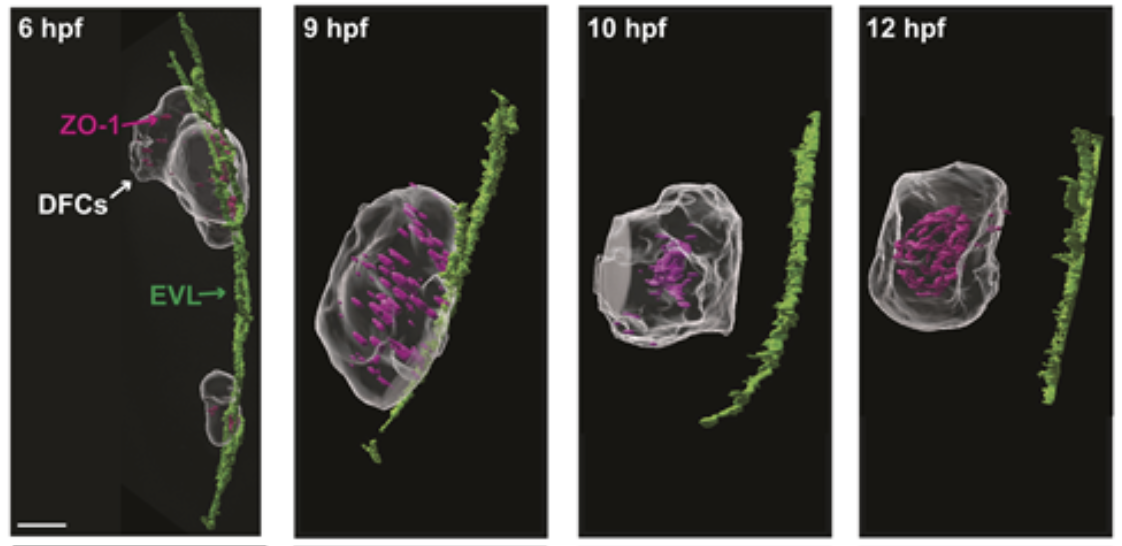
As Kupffer’s vesicle forms (6 to 12 hpf), dorsal forerunner cells (gray) detach from the overlying enveloping layer (green) while ZO-1 (magenta) shifts from the contact surface to internal junctions.