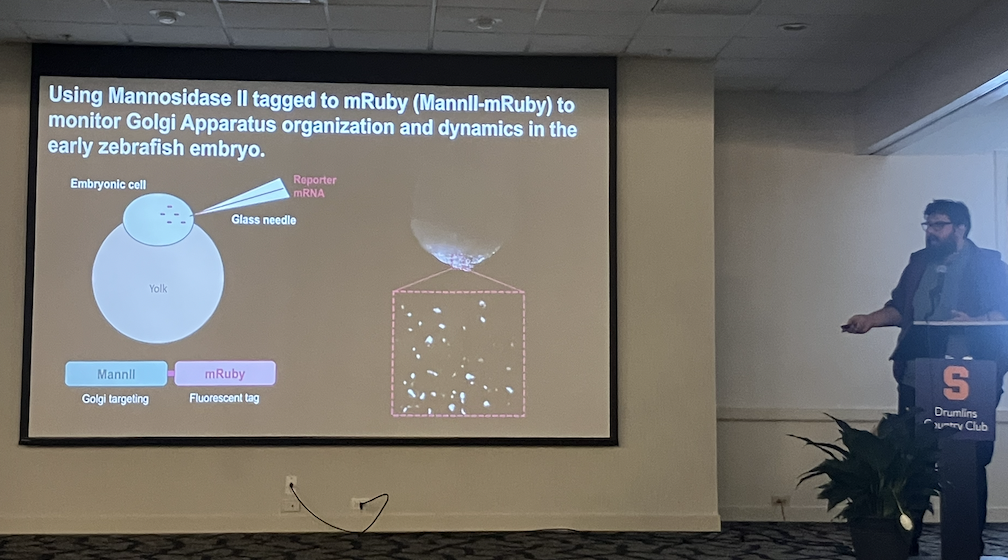
Congratulations to Albert Adhya, Hehnly and Hougland Lab Graduate Student, who presented a talk at the Syracuse University Biology Retreat on the role of the Golgi apparatus during zebrafish embryo development. 🐟🔬
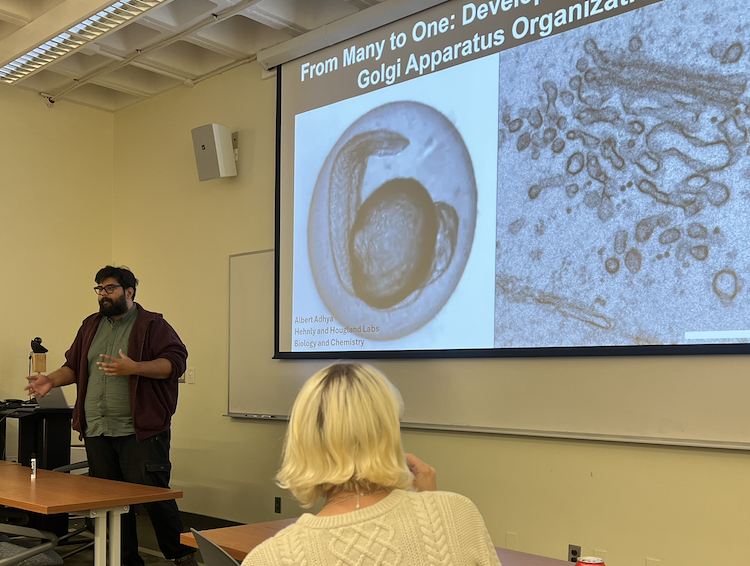
Albert Adhya Presents at Syracuse University Physics Soft Matter Seminar
Congratulations to Albert Adhya, a 4th-year Chemistry graduate student co-mentored by Dr. Jimmy Hougland (Chemistry) and Dr. Heidi Hehnly (Biology), who gave an invited talk today in the Physics Soft Matter seminar at Syracuse University. His work examines how the Golgi apparatus organizes during development.
Albert was invited by Dr. Mirna Skanata, and we're grateful to her and the Physics Soft Matter community for hosting him and for the opportunity to share our work.
Great work, Albert!
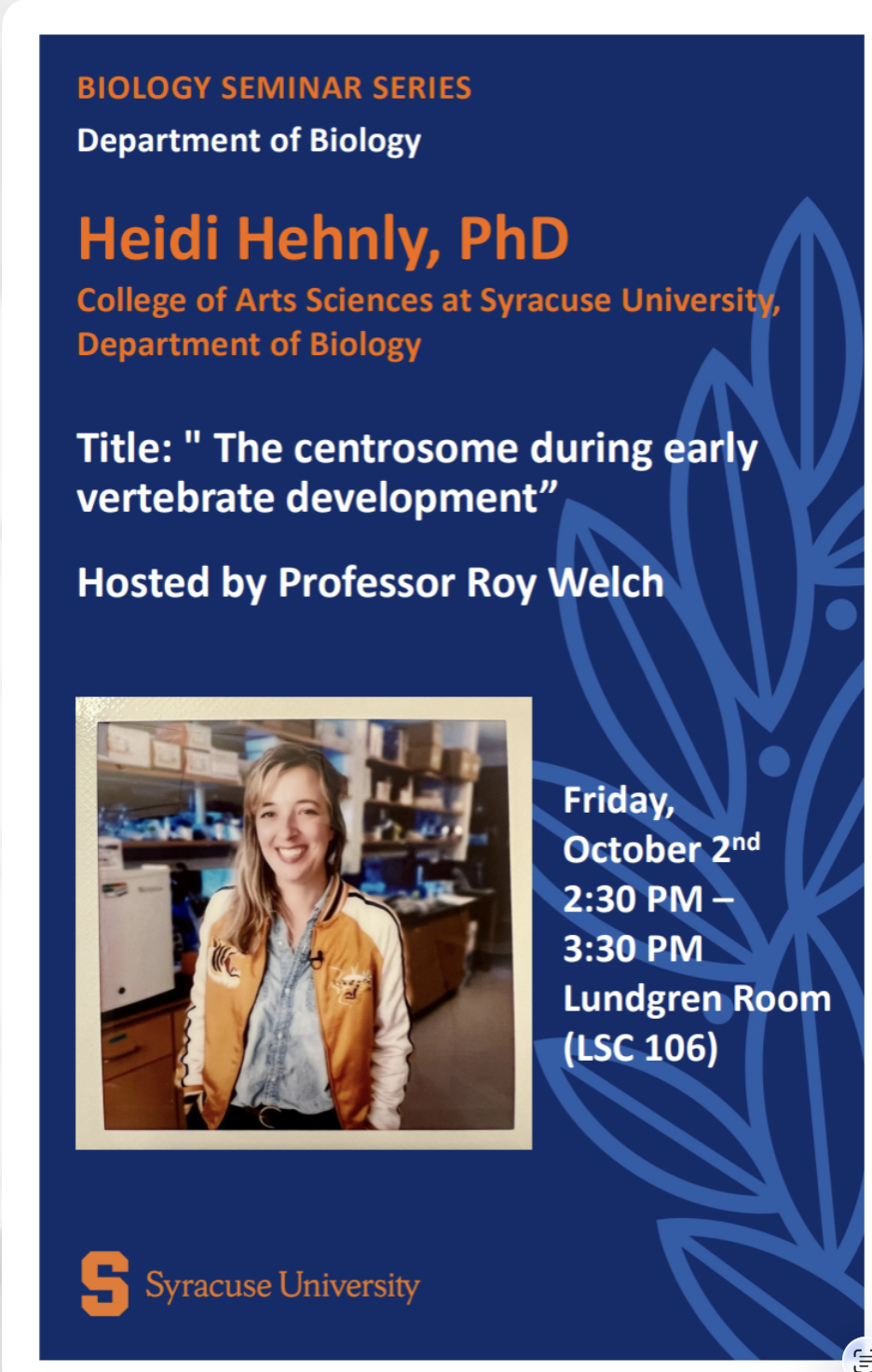
Dr. Heidi Hehnly Presents Departmental Seminar on the Centrosome in Early Vertebrate Development
On Friday, October 2nd, Dr. Heidi Hehnly gave a talk as part of the Department of Biology Seminar Series, titled "The centrosome during early vertebrate development."
The seminar took place in the Lundgren Room (LSC 106) and was hosted by Professor Roy Welch.
Thank you to Professor Welch for hosting, and to everyone who came and joined the discussion.
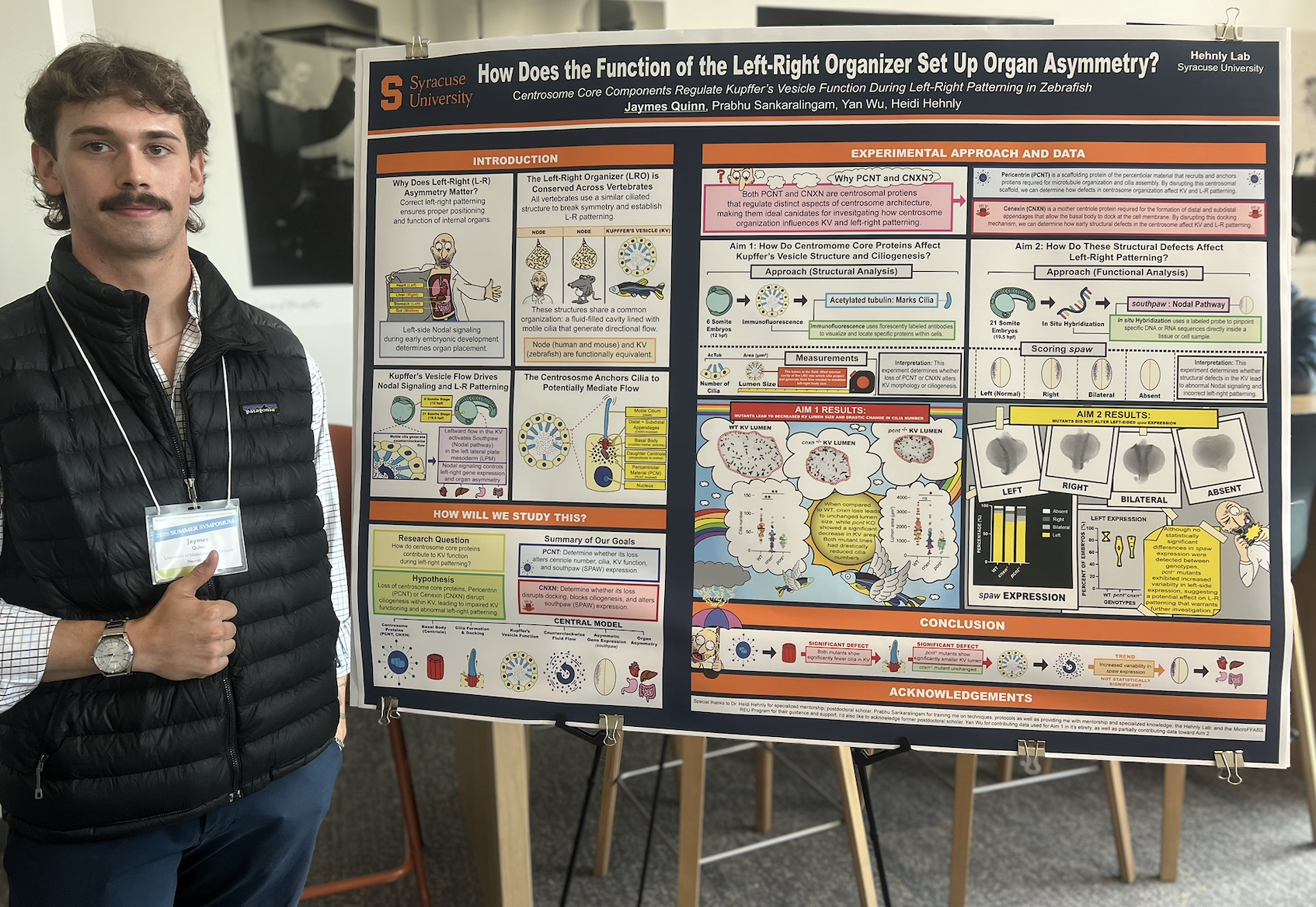
Where Art Meets Science: Jaymes Quinn's Summer in the Hehnly Lab
This summer, the Hehnly Lab welcomed Jaymes Quinn, an undergraduate from UMass Amherst, as a visiting student through MicroFFABS, Syracuse University's Biology Department REU (Research Experiences for Undergraduates) program focused on microscopy. Over the course of his time in the lab, Jaymes asked: how does the body know its left from its right?
Jaymes's project, "How Does the Function of the Left-Right Organizer Set Up Organ Asymmetry?", focused on the Kupffer's vesicle — a fluid-filled structure in zebrafish embryos that acts as the left-right organizer (LRO). This tiny organ is responsible for kicking off the signals that tell a developing embryo which side is which, ultimately shaping how organs like the heart get positioned correctly in the body.
Working alongside Prabhu Sankaralingam (postdoc) and PI Heidi Hehnly, Jaymes investigated how centrosome core components — specifically proteins called Pericentrin (pent) and Cenexin (cnxn) — regulate the structure and ciliogenesis of the Kupffer's vesicle. Using immunofluorescence, in situ hybridization, and careful scoring of spaw (southpaw) expression patterns, Jaymes and the team pieced together how defects at the centrosome level can throw off the entire left-right patterning process.
Jaymes brought his background in illustration into the lab, hand-drawing figures that walked viewers through the biology: stylized embryos, cilia, and vesicles that made a genuinely complex topic approachable at a glance. He presented this work at a combined summer research festival for undergrads at SUNY ESF, SUNY Upstate, and Syracuse University.
Thanks to Jaymes Quinn, Prabhu Sankaralingam, and the entire Hehnly Lab for a great summer of research.