We are pleased to share our latest preprint, now available on BioRxiv:
Read the Preprint
Understanding how epithelial architecture emerges de novo during development remains a central question in cell and developmental biology, particularly in systems where polarity and junctional organization must be established without a pre-existing template. The zebrafish left–right organizer provides a tractable in vivo context to define how transient cell–cell interactions are coordinated with cytoskeletal remodeling to drive tissue morphogenesis.
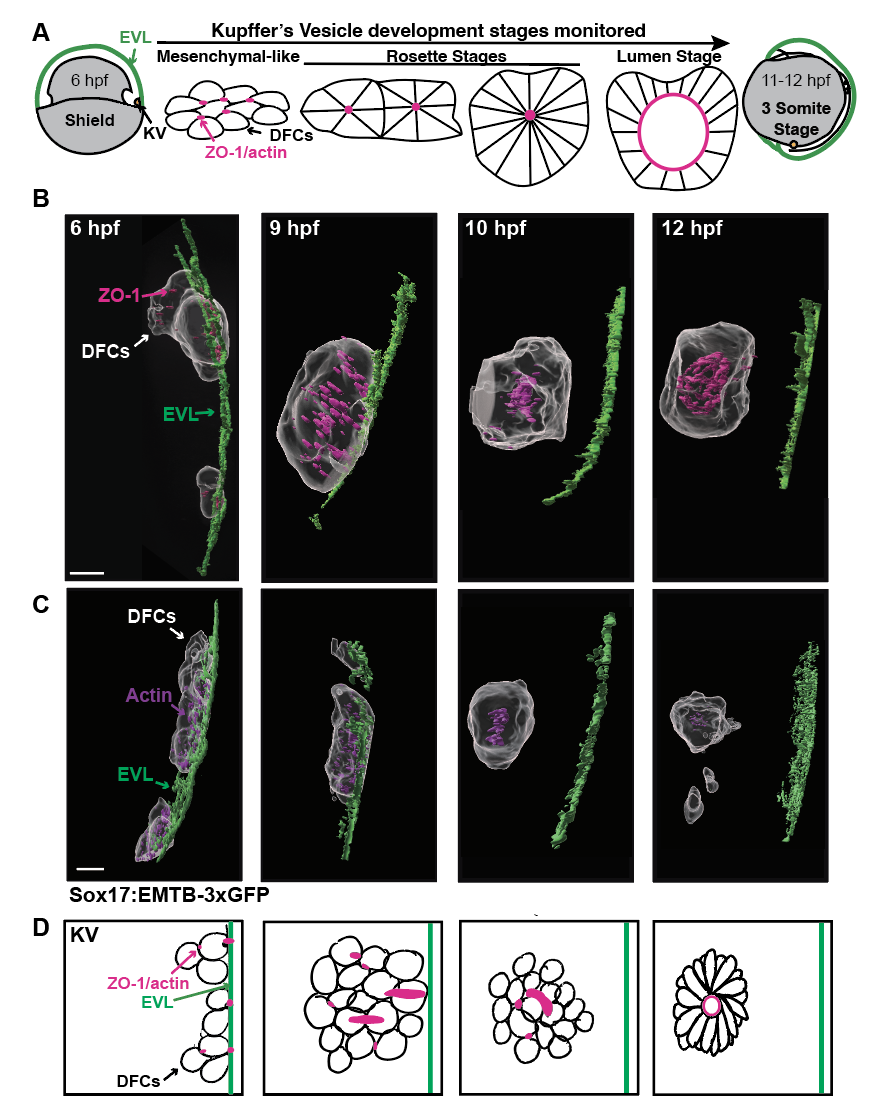
Our recent study, now available on bioRxiv, examines how dorsal forerunner cells (DFCs) dynamically remodel junctional architecture during Kupffer’s vesicle morphogenesis. Led by postdoctoral researcher Yan Wu, graduate student Yiling Lan, and exceptional undergraduate researchers Athena Allred and Carys Timpson, the work combines high-resolution imaging with quantitative analyses to show that ZO-1–based junctional assemblies form at DFC–EVL interfaces and are progressively reorganized as DFCs transition into a cohesive epithelial cyst. In parallel, we identify a role for early mitotic events and cytokinetic bridge–derived microtubule bundles in organizing actin enrichment and nucleating rosette-like structures, linking cell division to the emergence of epithelial architecture during left–right organizer development.