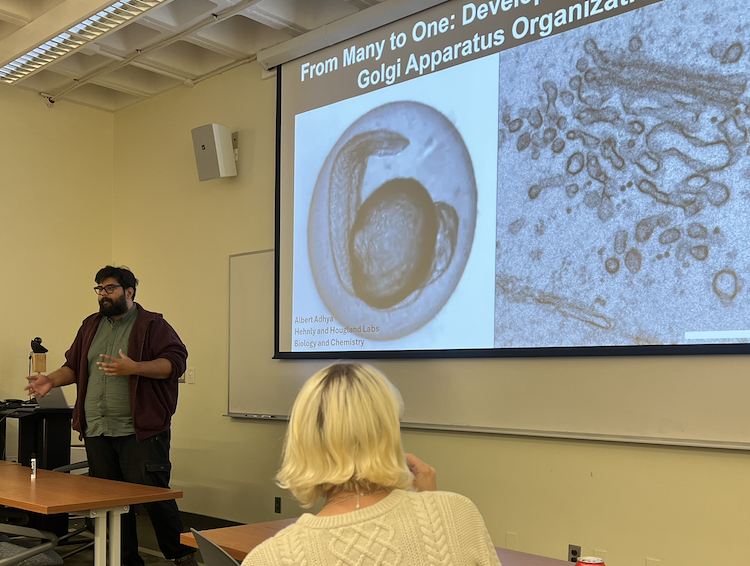
Albert Adhya Presents at Syracuse University Physics Soft Matter Seminar

by Heidi Hehnly in , ,


Congratulations to Albert Adhya, a 4th-year Chemistry graduate student co-mentored by Dr. Jimmy Hougland (Chemistry) and Dr. Heidi Hehnly (Biology), who gave an invited talk today in the Physics Soft Matter seminar at Syracuse University. His work examines how the Golgi apparatus organizes during development.

Albert was invited by Dr. Mirna Skanata, and we're grateful to her and the Physics Soft Matter community for hosting him and for the opportunity to share our work.

Great work, Albert!


Speaking at Mount Sinai's Department of Cell, Developmental & Regenerative Biology

by Heidi Hehnly in , ,


On May 21st Dr. Hehnly gave an invited talk at Mount Sinai's Department of Cell, Developmental and Regenerative Biology, hosted by Dr. Sergei Sokol. The seminar presented work from two members of the lab — Favour Ononiwu, Yiling Lan and Prabhu Sankaralingam — focused on centrosome dynamics and the consequences of centrosome protein loss in the zebrafish embryo.

The zebrafish embryo offers a powerful window into early cell division, and this work addresses how the centrosome is regulated during those critical first stages of development. 

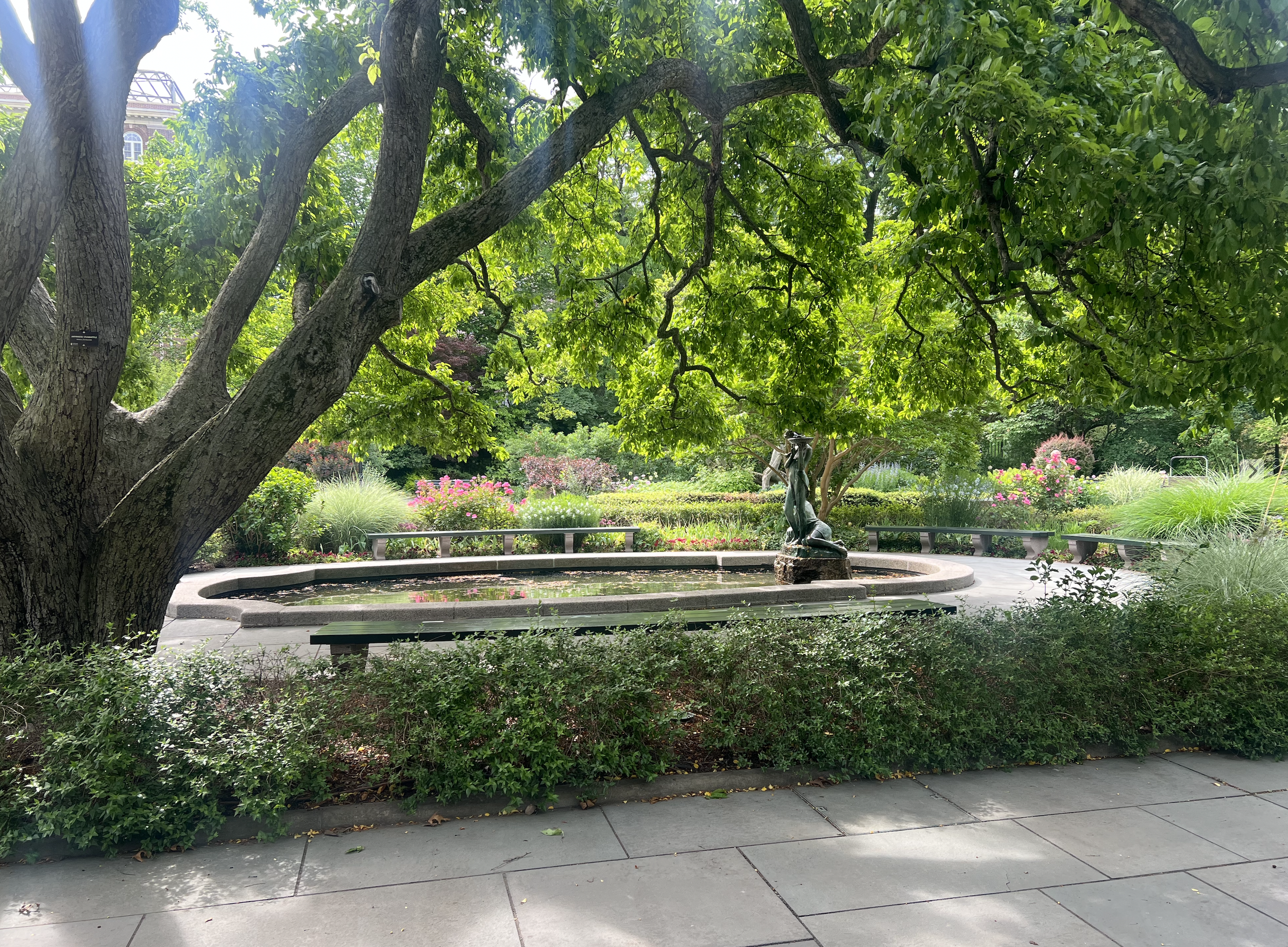
Dr. Hehnly had a great time visiting the Department and Central Park!


BioArt Mixer #22: Rewriting Intelligence Across Nature, Story, and AI

by Heidi Hehnly in ,


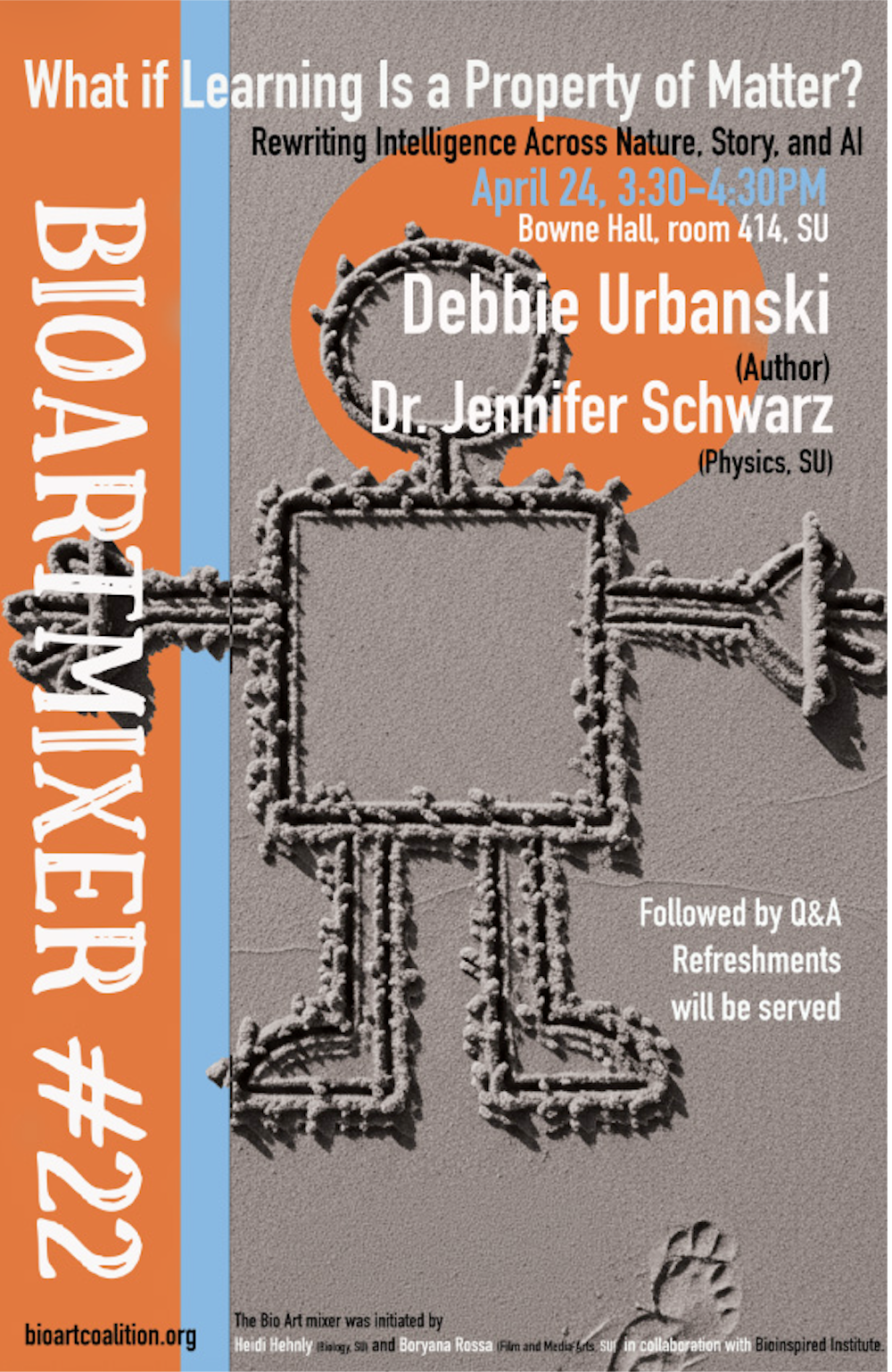
Join us for the next BioArt Mixer, an interdisciplinary conversation exploring how concepts of learning extend across physics, biology, narrative, and artificial systems.

📅 April 24, 3:30–4:30 PM
📍 Bowne Hall, Room 414, Syracuse University

What if Learning Is a Property of Matter?
Rewriting Intelligence Across Nature, Story, and AI

This session features a conversation between Debbie Urbanski and Jen Schwarz, followed by Q&A and refreshments.

We often localize learning within brains—or in artificial neural networks modeled after them. This discussion instead asks whether learning may be a more fundamental property of matter itself: emerging in systems that encode history, respond to perturbation, and reorganize through interaction. Framed through both scientific and narrative lenses, the event explores how learning may be written into the fabric of physical and conceptual worlds.

Schwarz’s work in theoretical physics examines how diverse systems—from particle assemblies to cellular collectives—can encode memory and exhibit adaptive behavior through physical processes. Urbanski’s speculative writing, including After World and her recent collection Portalmania, approaches similar questions through narrative, imagining intelligence and learning beyond human-centered frameworks.

The BioArt Mixer series, initiated by Heidi Hehnly and Boryana Rossa in collaboration with the Bioinspired Institute, brings together perspectives across disciplines to foster new ways of thinking at the intersection of science and art.

All are welcome.

Lab Highlights from ASCB 2025 in Philadelphia

by Heidi Hehnly in , ,


This December, members of the Hehnly Lab traveled to Philadelphia to present their work at the 2025 American Society for Cell Biology (ASCB) Annual Meeting.

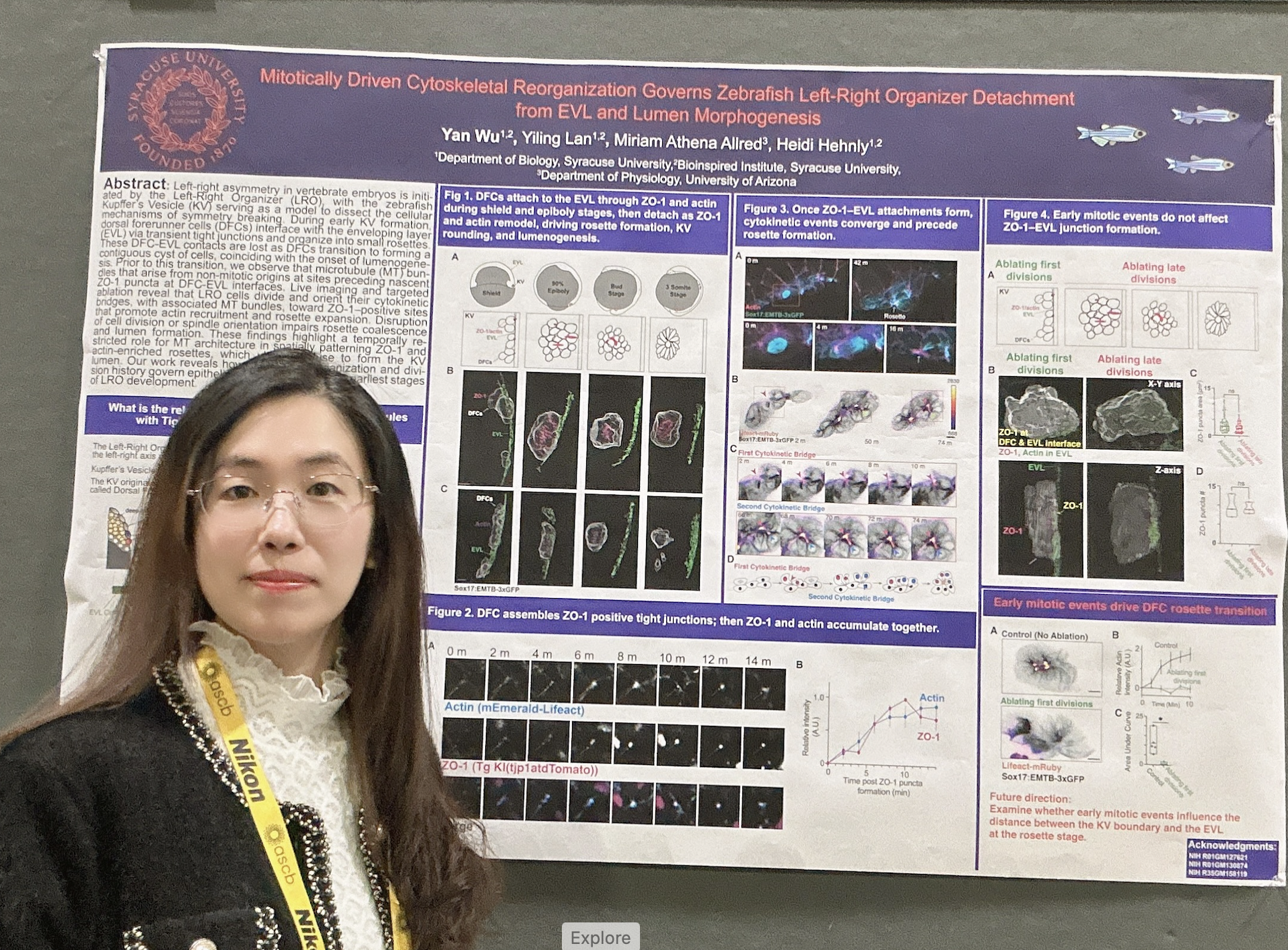
Yan Wu presented her poster, “Mitotically driven cytoskeletal reorganization governs zebrafish left–right organizer detachment from the EVL and lumen morphogenesis.” This work highlights how dynamic mitotic events shape tissue architecture during early embryogenesis and reflects a major collaborative effort within the lab. In addition to Yan’s leadership on the project, Yiling Lan and summer undergraduate Miriam Athena Allred made substantial experimental and conceptual contributions, with additional contributions from Carys Timpson during her summer research period.

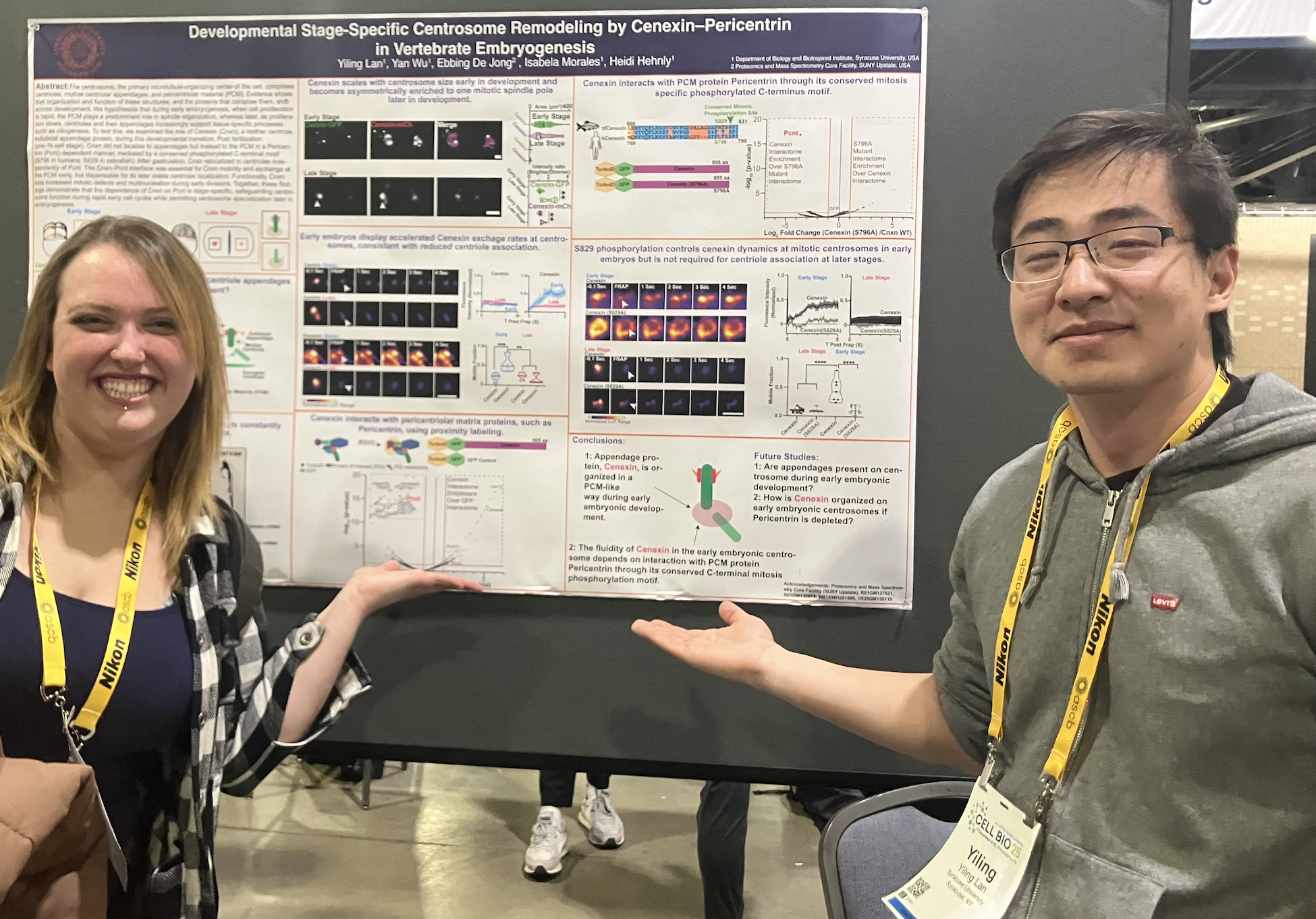
Yiling Lan also presented his work, “Developmental stage–specific centrosome remodeling by cenexin–pericentrin in vertebrate embryogenesis,” which explores how centrosome composition and organization are developmentally regulated to support morphogenesis. While at ASCB, Yiling had the opportunity to reconnect with former lab member Erin Curtis, now completing her PhD jointly at MIT and Duke— a reminder of the extended scientific community that grows from shared training experiences.

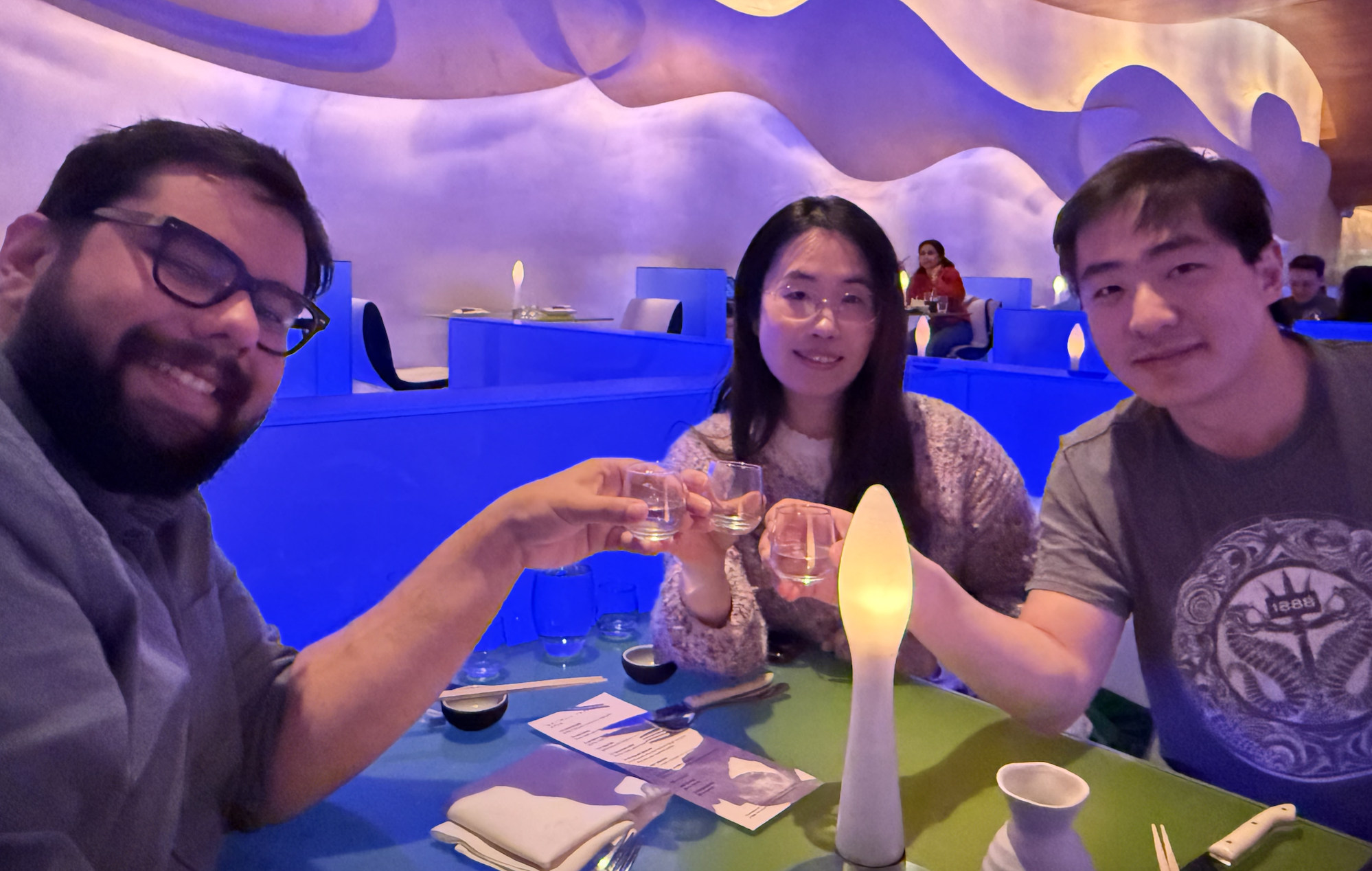
We were also excited to have Albert Adhya attend ASCB as he begins his journey in the lab. For Albert, the meeting served as an immersive introduction to the broader cell biology community and an opportunity to see firsthand how scientific ideas are communicated and refined. The group capped off the meeting with a celebratory dinner at Morimoto—an excellent way to mark a successful and energizing conference.