New Preprint: Cytoskeletal Remodeling and Junction Dynamics During KV Morphogenesis

by Heidi Hehnly in


We are pleased to share our latest preprint, now available on BioRxiv:
Read the Preprint

Understanding how epithelial architecture emerges de novo during development remains a central question in cell and developmental biology, particularly in systems where polarity and junctional organization must be established without a pre-existing template. The zebrafish left–right organizer provides a tractable in vivo context to define how transient cell–cell interactions are coordinated with cytoskeletal remodeling to drive tissue morphogenesis.

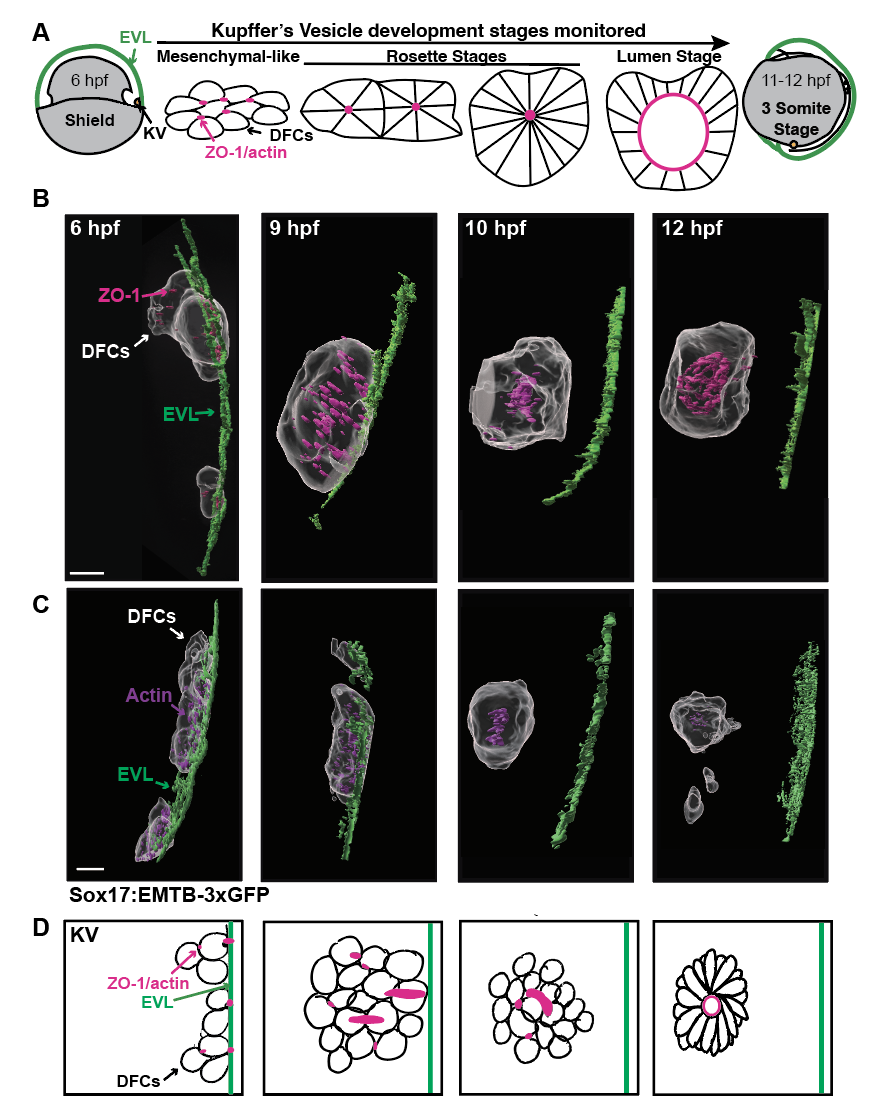
Our recent study, now available on bioRxiv, examines how dorsal forerunner cells (DFCs) dynamically remodel junctional architecture during Kupffer’s vesicle morphogenesis. Led by postdoctoral researcher Yan Wu, graduate student Yiling Lan, and exceptional undergraduate researchers Athena Allred and Carys Timpson, the work combines high-resolution imaging with quantitative analyses to show that ZO-1–based junctional assemblies form at DFC–EVL interfaces and are progressively reorganized as DFCs transition into a cohesive epithelial cyst. In parallel, we identify a role for early mitotic events and cytokinetic bridge–derived microtubule bundles in organizing actin enrichment and nucleating rosette-like structures, linking cell division to the emergence of epithelial architecture during left–right organizer development.
Welcoming New Undergraduate Researchers to the Hehnly Lab

by Heidi Hehnly in


The Hehnly Lab is pleased to welcome two new undergraduate researchers this semester, Izabella Shaina Naloy and Emily Dillon, who are contributing to ongoing projects focused on early embryonic development.

Izabella Naloy, a Biology and Forensics major, is working with postdoctoral researcher Prabhu on studies examining centriole dynamics during the earliest stages of development. Her work focuses on tracking centrioles as cells divide and reorganize during embryogenesis, an approach that will help us better understand how centrosome inheritance and positioning contribute to early developmental patterning.

Emily Dillon, an Engineering student, has joined the group working with graduate researcher Yiling Lan to investigate spindle positioning during early embryonic cell divisions. Using quantitative imaging approaches, Emily is helping measure how mitotic spindles orient and position within cells, an important determinant of cell division symmetry and tissue organization during development.

Welcome!


Welcoming Dr. Prabhu Sankaralingam to the Hehnly Lab

by Heidi Hehnly in


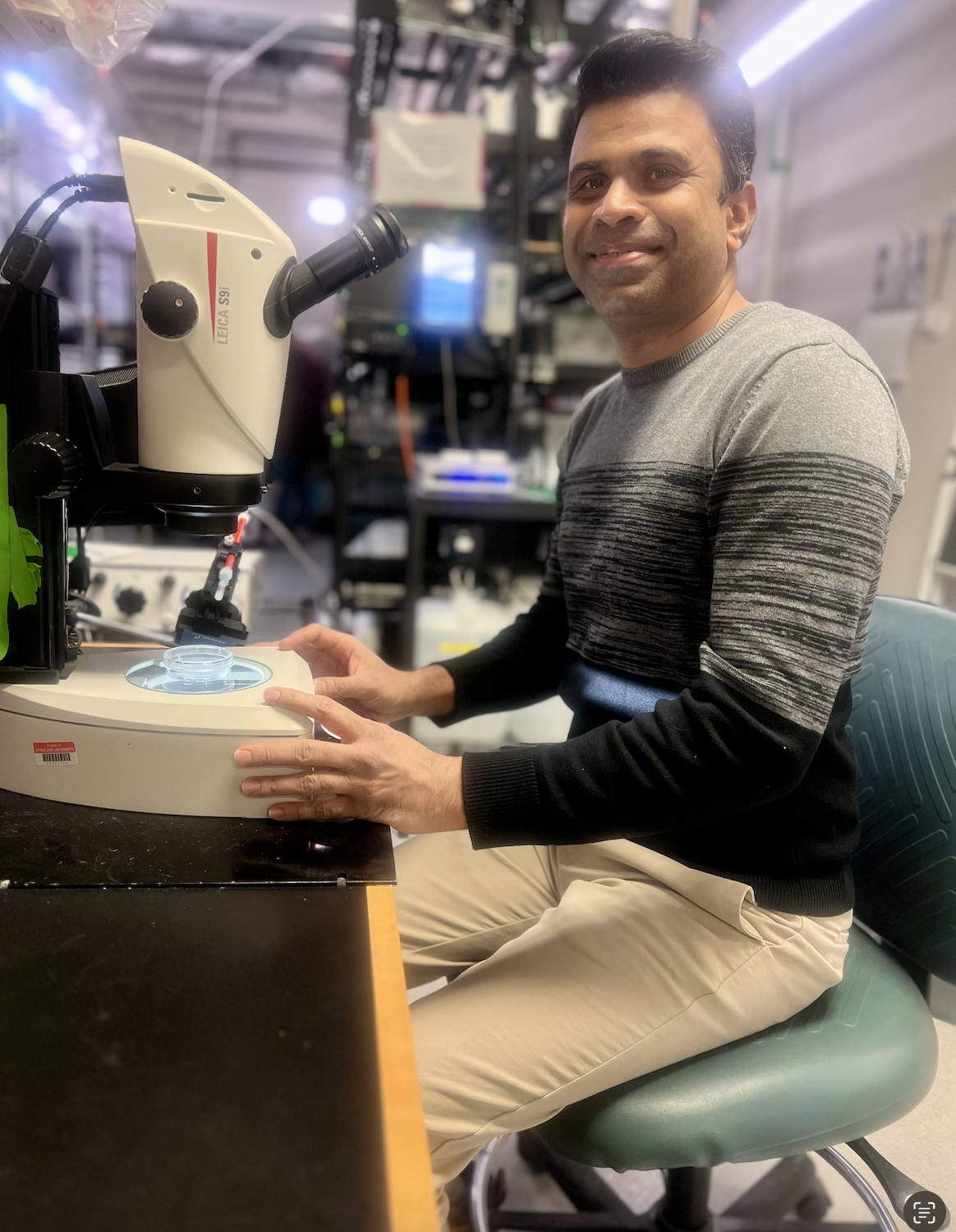
We are pleased to welcome Dr. Prabhu Sankaralingam to the Hehnly laboratory as a postdoctoral researcher. Prabhu brings extensive expertise in centriole biogenesis and centrosome biology, with a strong foundation in C. elegans as a model system for dissecting the molecular mechanisms that govern centriole assembly and duplication.

His recent work has provided important mechanistic insight into how the kinase ZYG-1 regulates centriole assembly through phosphorylation of the cartwheel protein SAS-5, highlighting the critical role of post-translational modification in centriole formation and copy number control. This study, published in EMBO Reports (read more here: https://link.springer.com/article/10.1038/s44319-024-00157-y).

In the Hehnly lab, Prabhu will extend these questions into vertebrate development using zebrafish, where he will investigate mechanisms of centriole biogenesis and maintenance in the context of embryonic tissues and ciliated structures. His expertise in centriole biology and quantitative analysis of assembly pathways will complement ongoing efforts in the lab to understand centrosome function during development and tissue morphogenesis.

We are excited to have Prabhu join our research community and look forward to the new directions his work will bring to our studies of centrosome and cilia biology.


BioArt Mixer--> Aphrodite’s Conception: Where Reproductive Biology Meets Myth and Art

by Heidi Hehnly in


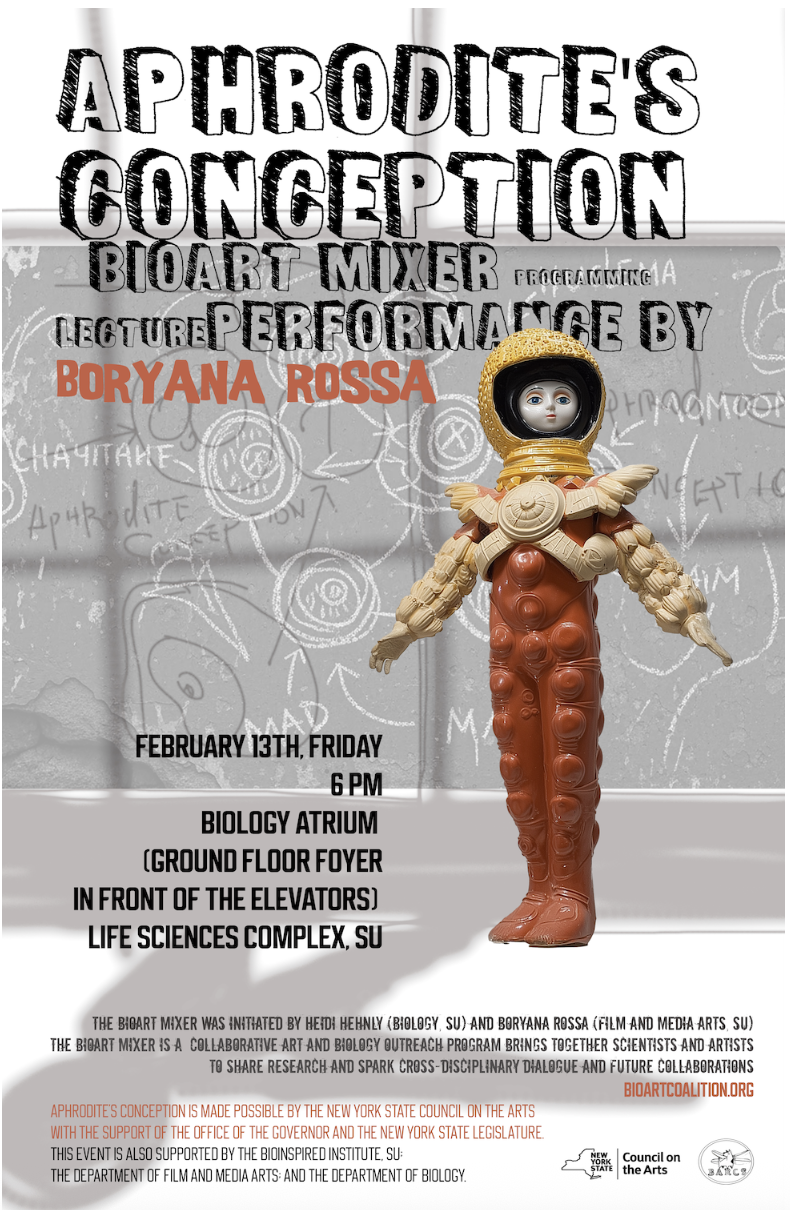
On February 13, the Life Sciences Complex will host an evening at the intersection of biology, art, and speculative futures. Aphrodite’s Conception: Reproduction Myths and Contemporary Biotechnology brings together faculty, students, and the broader university community for a live lecture-performance and Bio-Art Mixer event centered on the evolving narratives of reproduction and care.

The event features artist Boryana Rossa, Professor of Film and Media Arts and Artist-in-Residence in the Hehnly laboratory, whose interdisciplinary work explores how emerging reproductive technologies reshape social structures and cultural imagination. Developed through sustained dialogue with developmental and cell biology research, this performance examines parallels between ancient myths of conception and contemporary biotechnological advances such as in vitro fertilization, artificial wombs, cloning, and stem cell–based organismal development.

Through live visual and textual performance, Rossa draws connections between mythological accounts of self-conception, nontraditional parenthood, and technologically mediated reproduction. These narratives serve as a framework for examining how scientific innovation influences societal understandings of caregiving, embodiment, and kinship. By juxtaposing myth and biotechnology, the work highlights recurring archetypes of conception and gestation that span cultural histories and emerging scientific possibilities.

The evening will also feature a live mural drawing by Rossa, offering attendees the opportunity to observe the creative process as it unfolds and to engage directly with the conceptual development of her forthcoming work. Following the performance, a guided discussion will invite reflection on the scientific, cultural, and ethical dimensions raised by the project. Beverages and light refreshments will be provided.

This event is supported by the Department of Film and Media Arts, the Department of Biology, and the BioInspired Institute, and is part of the ongoing Bio-Art Mixer series initiated to foster dialogue between scientific and artistic communities at Syracuse University. By creating shared spaces for exchange, the series aims to expand how research is communicated, interpreted, and experienced across disciplines.

Aphrodite’s Conception is made possible by the New York State Council on the Arts with the support of the Office of the Governor and the New York State Legislature.