A nice surprise birthday celebration from the lab! Thank you everyone! I wouldn’t love this job so much if it wasn’t for everyone in the lab.
Left to Right: Amra, Abbi, Heidi, Nicole, CJ, Eric, Nikhila
by Heidi Hehnly in Lab Fun
A nice surprise birthday celebration from the lab! Thank you everyone! I wouldn’t love this job so much if it wasn’t for everyone in the lab.
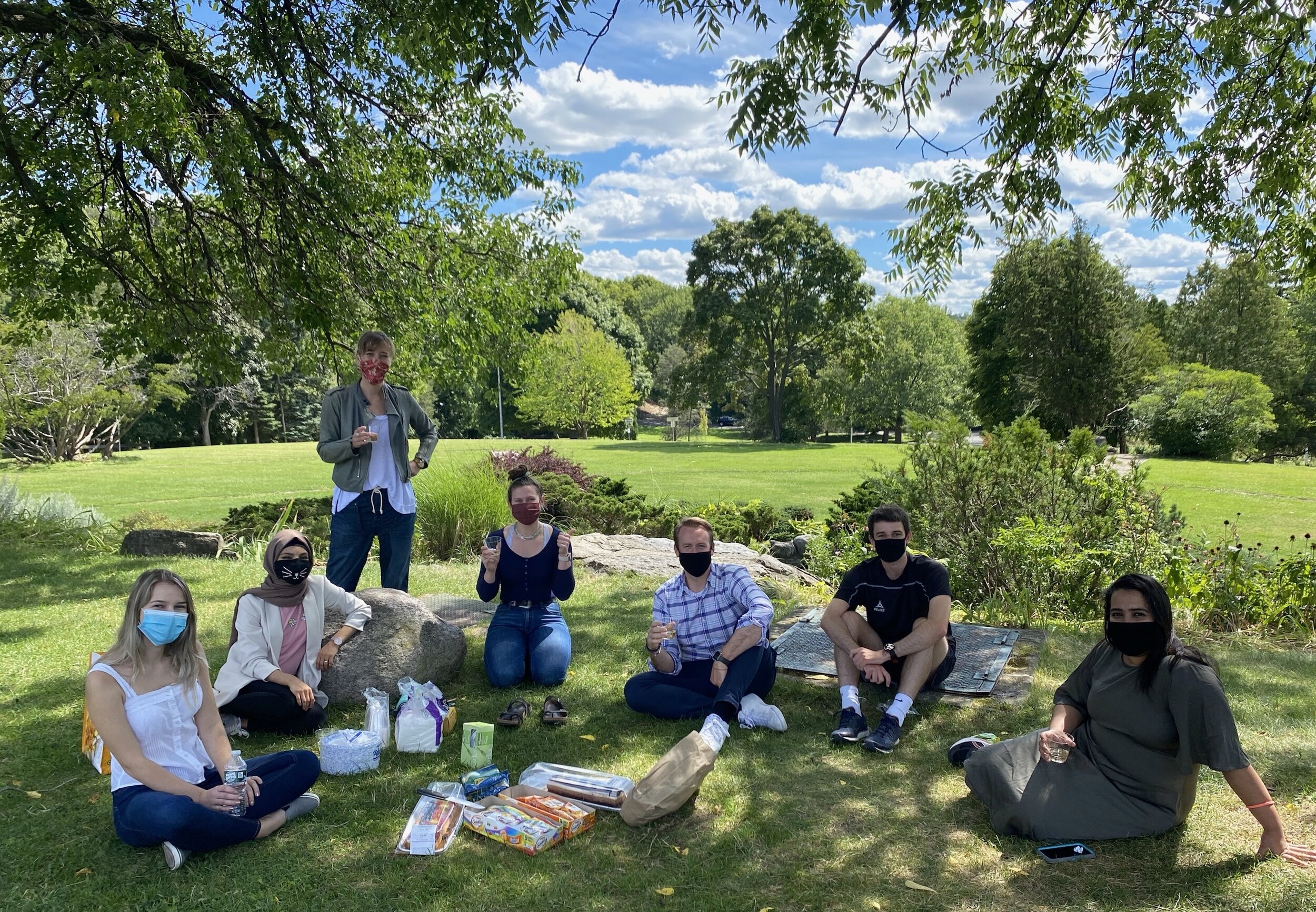
Left to Right: Amra, Abbi, Heidi, Nicole, CJ, Eric, Nikhila
by Heidi Hehnly in Lab Fun, Art, Collaborative Work
We have a great line-up for the next Bio Art Mixer this Thursday at 6:30 pm via zoom, featuring Biology's very own Mayra Cadorin Vidal! We have two other fabulous speakers Matej Vakula (PH.D. candidate in electronic Arts at RPI) and Jenifer Wightman (Dept of Crop and Soil Science at Cornell University). This is the second part of the two day symposium in which we will have hosted a total of seven talks by artists and scientists. After these 3 talks, we will follow up with a Q&A.
Come check out the event at our Facebook page: https://www.facebook.com/events/295929411504205/
The Bio-Art Mixer has been initiated by Heidi Hehnly, Ph.D. Biology, SU; Boryana Rossa Ph.D. Transmedia, SU in collaboration with Canary Lab.

by Heidi Hehnly in News
A postdoctoral position is available in our lab to study the role of cell division in tissue morphogenesis using the zebrafish embryo. Women and URM are encouraged to apply. Contact Heidi for further information at hhehnly at syr.edu.
The Hehnly lab focuses on a broad question: How do ciliated cells develop into a functional polarized organ? We propose that this occurs through a sequential process that starts with cell division and placement of the cytokinetic midbody, which marks a site for where the apical membrane should be placed. Once cytokinesis completes, cilia assembly occurs. If a ciliated organ is to expand its central lumen, cells need to re-enter the cell cycle and correctly position their mitotic spindle along the longest axis parallel to the lumen. We test a model in which the centrosome is essential during this process, modulating signaling events to: 1) regulate spindle assembly and positioning, 2) direct events to assist in the final stage of cell division, cleavage of the cytokinetic bridge (abscission), and 3) direct apical polarity and formation of a primary cilium. To identify the mechanisms involved in these processes we use mammalian cell culture and the model vertebrate Danio rerio (Zebrafish) coupled with advance light-microscopy, biochemical, and molecular approaches. We currently seek a researcher with a background in cell biology and microscopy. The position is for a Postdoctoral Research who will be funded by an NIH R01. Specific research goals will be discussed and agreed upon with the principal investigator (Heidi). Please apply by sending a cover letter, CV, and job references to Heidi.
Come hang out with us in Syracuse!
by Heidi Hehnly in Art, Lab Fun, Collaborative Work

Zoom ID: 960 6040 1646
July 23rd:
Jude Abu Zaineh Ph.D. Department of Arts, Rensselaer, Troy, NY
Darya Warner, Department of Fine Arts, University at Buffalo
Laura Markley, Ph. D. candidate in Civil and Environmental Engineering, Syracuse University
Julia Zeh, Ph. D. candidate in the Bioacoustics and Behavioral Ecology Lab, Syracuse University
Jude Abu Zaineh will give an overview of her practice which relies on the use of art, food, and technology to investigate meanings of cultural diaspora, displacement, and belonging. She examines ideas of home and community while working to develop aesthetics rooted in her childhood and upbringing in the Middle East.
Jude Abu Zaineh is a Palestinian-Canadian multidisciplinary artist and cultural worker. She was one of the first selected artists to participate in a collaborative residency with the Ontario Science Centre and MOCA Toronto (Canada). She has presented her work nationally and internationally including Cultivamos Cultura, São Luis, Portugal; Museu de Arte, Arquitetura e Tecnologia, Lisbon, Portugal; Centro de Cultura Digital, Mexico City, Mexico; SVA, NYC, USA; Ontario Science Centre, Toronto, Canada; Forest City Gallery, London, Canada; Artspeak Gallery, Windsor, Canada; Common Ground Gallery, Windsor, Canada. Abu Zaineh is currently pursuing her Ph. D. in Electronic Arts at Rensselaer Polytechnic Institute in upstate NY (USA).
Investigating Microplastic pollution in Onondaga and Skaneateles Lakes
Microplastics are an emerging contaminant in freshwater ecosystems, with regional importance for water resources in central New York. Microplastics can wash into lakes and streams from wastewater effluent, degraded litter, personal care products, car tire abrasion, and many other sources, where they may facilitate the transport of contaminants and be ingested by wildlife. This work, funded by the USGS, aims to characterize the abundance, distribution, and potential sources of microplastics in Onondaga Lake and its major tributaries and outlets, as well as a general survey of Skaneateles Lake, which provides drinking water for the city of Syracuse.
Laura Markley is a Ph. D. candidate in Civil and Environmental Engineering advised by Dr. Charles Driscoll and Dr. Andria Costello-Staniec. She has her B.S. and M.S. in Environmental Earth Science and has research experience spanning multiple disciplines, including the geosciences and soil geochemistry. Her dissertation work is focused on the impacts of the life cycle of plastic on human and environmental health. She also runs an educational website, wastefreephd.com, communicating the science of waste to a broad audience.
MycoPrinter
MycoPrinter is an open-source 3D bioprinter that prints mycelium substrate ready for inoculation with various types of fungi thus combining additive manufacturing with biological tissue to create a living sculpture. It aims to bring together engineering, biological sciences, and art under the umbrella of open citizen science. As a traveling artwork, it becomes a major contributor to the series of site-specific temporal sculptures. The first site MycoPrinter will address is Buffalo China Factory will and explore our relationship with local ecological systems (fungi) through technology in the form of the new hybrid matter. MycoPrinter has a much broader intended application besides “mycoprinting”. It is designed to print beyond fungi, to be versatile and mobile, inexpensive, and easily assembled under limited access to the materials.
Darya Warner works at the intersection of art and science with an emphasis on the interconnectivity of intelligence across species through the prism of Climate Change. Her projects explore the Biophilia Hypothesis, also known as “the love of all living thing”, as a crucial factor in reconnecting humans and nature via interactive installations, visual displays, photography, sound, time- based media, and bioart in the new form of hybrid matter. She addresses issues of environmental impact among artists and connects creative processes to earth-conscious practices, which is a cornerstone of her research on sustainable art practices.
Julia Zeh is a Ph. D. candidate in the Bioacoustics and Behavioral Ecology Lab working with Dr. Susan Parks. She earned a B.A. from Columbia University in 2018 before enrolling at Syracuse where she is a National Defense Science and Engineering Graduate Fellow. Julia is interested broadly in the ecology and evolution of complex animal communication systems, with a focus on baleen whale acoustic signals. Additionally, she is interested in science communication, education, and outreach.
Recordings of our Bio-Art Mixers can be found here: https://bit.ly/2VwPeFl
Images by Jude Abu Zaineh and Darya Warner
The Bio-Art Mixer has been initiated by Heidi Hehnly, Ph.D. Biology, SU; Boryana Rossa Ph.D. Transmedia, SU in collaboration with Canary Lab.