Celebrating Yan Wu’s Next Chapter

by Heidi Hehnly in


We are excited to share that Yan Wu will be transitioning from the Hehnly Lab as she begins an exciting new position in Boston.

During her time in the lab, Yan made foundational contributions to our understanding of left–right organizer development, particularly through her work on mitotic regulation, cytoskeletal organization, and tissue morphogenesis in zebrafish. Her leadership on projects examining cytokinetic bridges, microtubule dynamics, and epithelialization has been instrumental in shaping several ongoing and published studies. Beyond her scientific contributions, Yan has been an exceptional mentor and collaborator, fostering a rigorous and supportive research environment.

We are grateful for Yan’s many contributions to the lab and look forward to seeing the continued impact of her work in this next phase of her career. We wish her all the best in Boston.

Left to Right: Prabhu, Albert, Isa, Yan, Amy, Joey, Lan, Heidi

Hehnly Lab Highlight: Favour Ononiwu Interview on Recent Study

by Heidi Hehnly in ,


We are excited to share a first-person interview featuring Hehnly Lab PhD graduate Favour Ononiwu, discussing her recent work on the zebrafish left–right organizer. Her study provides new structural insights into centrosomes and cilia using volume electron microscopy, advancing our understanding of how cellular architecture supports developmental patterning.

Hear directly from Favour about the scientific motivation, experimental approaches, and key findings behind this work:
👉 Read the interview


Welcoming New Undergraduate Researchers to the Hehnly Lab

by Heidi Hehnly in


The Hehnly Lab is pleased to welcome two new undergraduate researchers this semester, Izabella Shaina Naloy and Emily Dillon, who are contributing to ongoing projects focused on early embryonic development.

Izabella Naloy, a Biology and Forensics major, is working with postdoctoral researcher Prabhu on studies examining centriole dynamics during the earliest stages of development. Her work focuses on tracking centrioles as cells divide and reorganize during embryogenesis, an approach that will help us better understand how centrosome inheritance and positioning contribute to early developmental patterning.

Emily Dillon, an Engineering student, has joined the group working with graduate researcher Yiling Lan to investigate spindle positioning during early embryonic cell divisions. Using quantitative imaging approaches, Emily is helping measure how mitotic spindles orient and position within cells, an important determinant of cell division symmetry and tissue organization during development.

Welcome!


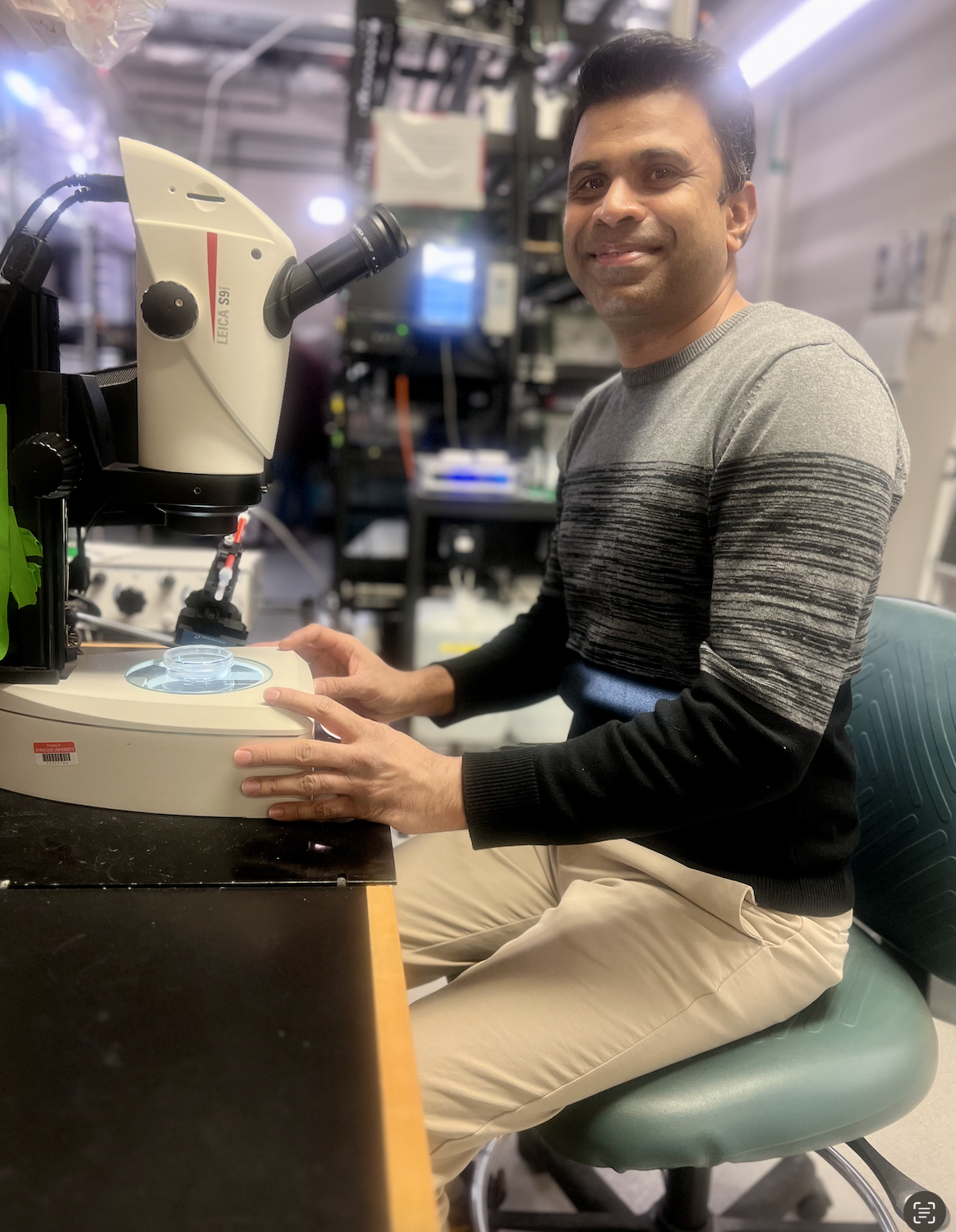
Welcoming Dr. Prabhu Sankaralingam to the Hehnly Lab

by Heidi Hehnly in


We are pleased to welcome Dr. Prabhu Sankaralingam to the Hehnly laboratory as a postdoctoral researcher. Prabhu brings extensive expertise in centriole biogenesis and centrosome biology, with a strong foundation in C. elegans as a model system for dissecting the molecular mechanisms that govern centriole assembly and duplication.

His recent work has provided important mechanistic insight into how the kinase ZYG-1 regulates centriole assembly through phosphorylation of the cartwheel protein SAS-5, highlighting the critical role of post-translational modification in centriole formation and copy number control. This study, published in EMBO Reports (read more here: https://link.springer.com/article/10.1038/s44319-024-00157-y).

In the Hehnly lab, Prabhu will extend these questions into vertebrate development using zebrafish, where he will investigate mechanisms of centriole biogenesis and maintenance in the context of embryonic tissues and ciliated structures. His expertise in centriole biology and quantitative analysis of assembly pathways will complement ongoing efforts in the lab to understand centrosome function during development and tissue morphogenesis.

We are excited to have Prabhu join our research community and look forward to the new directions his work will bring to our studies of centrosome and cilia biology.